
Accessability
The Eurovision is a platform to build bridges, promote understanding and celebrate the power of music together. We want to ensure that everyone can move around the city and between the different venues without assistance during their visit, regardless of their limitations. We therefore analyze the routes, identify gaps and develop measures to remove or reduce barriers.
Inclusive offers
As part of the Eurovision, numerous offers will be realized that enable access to content for people with disabilities.
Accessify.live offers low latency streaming on site via smartphone. Streams for audio, speech-to-text (for people with hearing aids), sign language (DE/FR/IT) and audio description (DE/FR/IT) can be selected after scanning a QR code.
The QR code will be displayed on screens in the entrance area of the St. Jakobshalle. If you have any questions, please contact the Accessibility Booth in the foyer, directly after ticket control.
For people with hearing aids, an FM hearing system has been installed in the St. Jakobshalle in addition to the streaming service. Anyone with a hearing aid, cochlear implant or other implant should report to the Accessibility Booth in the foyer of the St. Jakobshalle. There you will receive further information on how to use the audio signal.
SRG and Eurovision present a multi-sensory disco for people with and without hearing impairments. In addition to music, visitors will also be addressed on a tactile and visual level through vibrating elements on the dance floor, video clips and a music-timed light show.
Together with Pro Senectute beider Basel and Pro Senectute Switzerland, we will be holding an over-60s party for up to 1,000 people in Basel on May 3. The disco will further increase the anticipation for the Eurovision, exactly one week before the grand opening of the Eurovision show week. The needs of the target group will be taken into account and emphasis will be placed on accessibility.
The Eurovision Disco 60+ is very popular – tickets are already sold out.
Under the motto “Basel is getting ready for major inclusive events”, the Sitios association is carrying out a campaign on Wednesday, May 7, 2025 to collect accessibility information in the run-up to the Eurovision and WEURO in Basel. Volunteers are currently being sought to collect information on the accessibility of venues on this day. This will help people with disabilities to prepare for their visit to the event.
Odette Hella’Grand is one of Switzerland’s best-known drag queens and is bringing her show “Oh G! It’s Drag!” to the stage of the Eurovision Village. Now for the first time with live translation into Swiss German Sign Language (DSGS).
When: Monday, May 12, 2025
Time: 22:00
Where: Eurovision Village
Questions? Write to: accessibility@messe.ch
Touch Tour with ABBA GOLD especially for blind and visually impaired visitors at the Eurovision.
When: Wednesday, May 14, 2025
Time: 14:45
Where: at the entrance to the Eurovision Village, right-hand side.
Please register by e-mail to: accessibility@messe.ch
Trigger Warning
All events feature sensory stimuli such as loud noises, fog/smoke or strobe effects.
All events feature sensory stimuli such as loud noises, fog/smoke or strobe effects.
Getting to St. Jakob

By public transport:
- Please take tram line 14 to St. Jakobshalle or St. Jakob-Park. The St. Jakob tram stop is wheelchair accessible. If you are arriving from the SBB train station, we recommend changing at the Bankverein tram stop.
- However, Basel St. Jakob railway station (S-Bahn) is not wheelchair accessible, so the shuttle trains between Basel SBB railway station and Basel St. Jakob are unfortunately not recommended for people with disabilities.
By car:
- The drop-off and pick-up zone for wheelchair users is located on St. Jakobs-Strasse, near St. Jakobskirche. Access is via Zeughausstrasse only.
- Parking spaces are reserved on Muttenzerweg. Access to Muttenzerweg is via Birsstrasse only. Use of the parking spaces is permitted with a disabled parking permit only.
By taxi:
Various taxi companies offer transport for people with reduced mobility. A list of providers, including details of the number of wheelchair-accessible vehicles, can be found here:
KBB: Akkreditierte Transportunternehmen.
By public transport:
- Please take tram line 14 to St. Jakobshalle or St. Jakob-Park. The St. Jakob tram stop is wheelchair accessible. If you are arriving from the SBB train station, we recommend changing at the Bankverein tram stop.
- However, Basel St. Jakob railway station (S-Bahn) is not wheelchair accessible, so the shuttle trains between Basel SBB railway station and Basel St. Jakob are unfortunately not recommended for people with disabilities.
By car:
- The drop-off and pick-up zone for wheelchair users is located on St. Jakobs-Strasse, near St. Jakobskirche. Access is via Zeughausstrasse only.
- Parking spaces are reserved on Muttenzerweg. Access to Muttenzerweg is via Birsstrasse only. Use of the parking spaces is permitted with a disabled parking permit only.
By taxi:
Various taxi companies offer transport for people with reduced mobility. A list of providers, including details of the number of wheelchair-accessible vehicles, can be found here:
KBB: Akkreditierte Transportunternehmen.
St. Jakobshalle
St. Jakobshalle Basel is hosting the Eurovision from May 12 to 17. The St. Jakobshalle is partially wheelchair accessible. Assistance dogs are not permitted in the St. Jakobshalle.
All information about directions and drop off is listed under “Getting to St. Jakob”.
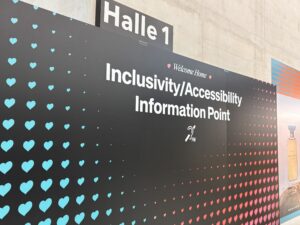
The entrance to St. Jakobshalle is wheelchair accessible. The Inclusivity/Accessibility Information Point is located in the foyer of St. Jakobshalle, where visitors can ask for assistance.
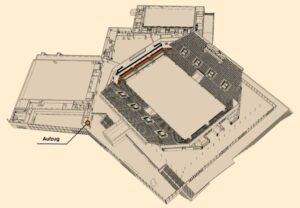
There is an elevator on the left-hand side of the hall which is reserved for people with disabilities and takes them to the 1st floor.
The wheelchair spaces (marked in orange) are located in sector B.
St. Jakob Park
On May 17, the Arena plus Public Viewing Show will take place in the St. Jakob-Park stadium. St. Jakob-Park is wheelchair accessible.
All information about directions and drop off is listed under “Getting to St. Jakob”.
The wheelchair spaces can be reached via two entrances in sectors C.
- Access with elevator, Birsstrasse 320 B
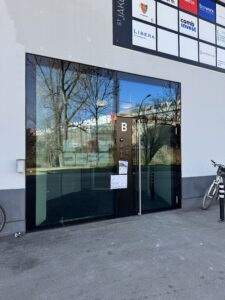
Someone will help you to get to the wheelchair level with the elevator.
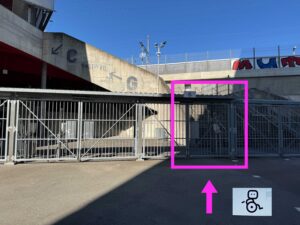
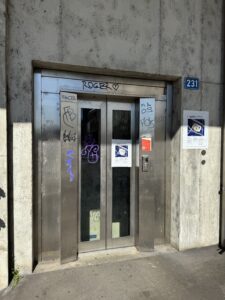
- Access with elevator, Gellertstrasse
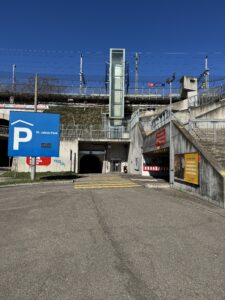
The elevator at Gellertstrasse can be operated independently.
The wheelchair level is located in the stadium on the C parquet level across the C1 to C6 parquet areas with color-coded floor markings. Next to each wheelchair space is the space for the accompanying person.
Liz Isler, FCB’s representative for people with disabilities, knows the stadium inside out and will also perform this function for the Eurovision. She will be available before May 17 and will also be on site during the event to assist other people. E-mail: liz.isler@fcb.ch
There are two toilets on the C-floor, which are accessible with a Euro-Key.
Messe Basel
From May 10 to 17, the Eurovision Village, EuroClub and Café will be offering entertainment at Messe Basel.
The Messe Center Basel is barrier-free.
There are 21 parking spaces for people with disabilities in the exhibition parking lot. Entrance height: 2.00 m
Hall 5 (in the parking garage building)
The checkroom and the Safer Space are located in Hall 5 and are accessible at ground level.
There is a public toilet in the immediate vicinity, next to the entrance to the checkroom, which is also accessible for people in wheelchairs.
Hall 1, North Foyer entrance
The Eurovision Village is barrier-free accessible.
- A total of two wheelchair-accessible toilets are available in Hall 1 (m/f/d). These toilets are exclusively for wheelchair users.
- A designated area in front of the stage is intended for wheelchair users and their companions and is marked accordingly.
- In the catering area, a seating area that can be rolled underneath is reserved for people in wheelchairs.
- A Quiet Room is available to retreat to or find peace and quiet. It is also possible to charge electric wheelchairs or cell phones there.
Event Hall, South Foyer entrance (1.0 South Foyer)
The EuroClub & Café is barrier-free accessible.
- A designated area in front of the stage is intended for people in wheelchairs and their companions and is marked accordingly.
- There are two barrier-free toilets in the EuroCafé area on the left-hand side of the foyer. These toilets are reserved exclusively for wheelchair users.
- In addition, there are four more barrier-free toilets on the gallery on the 1st floor, each in the toilets for women, men and non-binary persons. Please note that access to the gallery is only possible via a small elevator. The cabin width is only 100 cm. The elevator is therefore not suitable for larger wheelchairs.
Do you need a companion?
At the EuroClub, you can get a free additional ticket for your companion. Please send us an e-mail to accessibility@messe.ch with the following information:
- Name and e-mail address of the companion
- Your already purchased tickets (please attach them)
Basel Barrier-free
Basel is an open and diverse city. With its Disability Rights Act, the canton ensures that disadvantages for people with disabilities are eliminated. It promotes the equal participation of people with disabilities in all areas of life and is in contact with civil society organizations and self-advocacy groups. The focus is on accessible communication, the creation of an inclusive work environment, the political participation of people with disabilities, and the accessibility of public spaces for all.